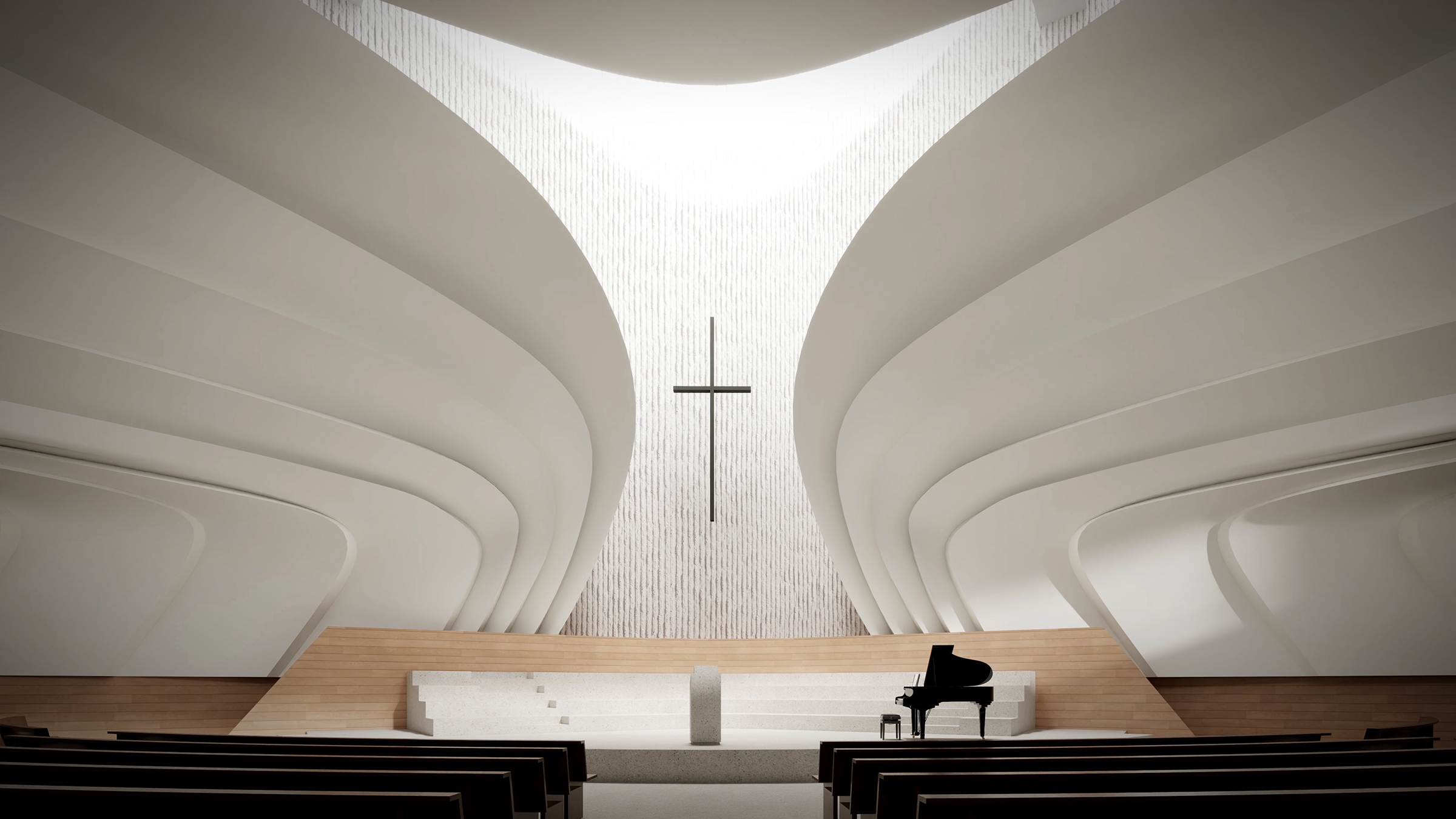
Sacred interiors have long relied on architecture to shape the experience of gathering, reflection, and belief. At Wanbao Christian Church in Fujian, China, the design team approaches that responsibility through a layered narrative that draws from both Christian symbolism and the maritime culture of Pingtan Island.
Rather than treating the interior as a neutral shell, the project extends the architectural language inward. The foyer, sanctuary, wedding hall, and courtyard are conceived as distinct chapters in a spatial sequence, each contributing to the larger experience of the building.
Symbols and abstract references to biblical stories help organize that journey. The intention is not simply to illustrate religious narratives, but to give visitors a sense that movement through the building has emotional and cultural meaning.
The connection to local marine culture is equally significant. Sacred architecture can sometimes appear detached from its immediate setting, as though its language must be universal to be meaningful. Wanbao Christian Church suggests another possibility: a space of worship can draw strength from the particular landscape and traditions surrounding it.
The design invites consideration of how contemporary interiors communicate without relying entirely on written explanation. Light, proportion, transition, and material can all contribute to a sense of reverence, though the experience will ultimately be shaped by the community that uses the church.
The project’s ambition is to make spiritual narrative spatial. Its success should be measured not only through photographs of the finished rooms, but through the ways those rooms support gathering, ceremony, and quiet attention.
A sacred space becomes most powerful when its symbolism remains open to human experience.
International Design Awards 2024 — Interior Design of the Year